
Key Takeaways
- Website speed directly affects user experience, bounce rates, and search engine rankings; slow sites lose visitors and rankings simultaneously.
- Google's Core Web Vitals (LCP, CLS, INP) are active ranking signals that measure real-world loading, visual stability, and responsiveness.
- Common causes of slow websites include unoptimised images, too many plugins, cheap shared hosting, and the absence of a CDN.
- Every 1-second delay in page load time can reduce conversions by up to 7%, making speed a direct business performance issue.
- Free tools like Google PageSpeed Insights and GTmetrix can diagnose speed problems in minutes, with no technical knowledge required.
Introduction
Website speed has become an important component in determining the success of your online presence in today's fast-paced digital world.
A fast-loading website may have a big influence on your online company, from increasing user experience to improving search engine results. In this post, we'll cover why why website loading speed is important for user experience and SEO, as well as practical steps for website speed optimisation, including page load time and caching.
User Experience: The Key to Retaining Visitors
The user experience is an important aspect in keeping visitors on your website. Users have a limited tolerance for slow-loading websites, difficult-to-use interfaces, and poor design.
As a result, it's critical that your website is easy to navigate, visually appealing, and loads rapidly. A pleasant user experience may result in improved engagement, longer site visits, and a higher conversion rate.
To improve user experience, prioritise website performance, simplify navigation, and make sure your content is easy to read. Pay attention to your design; it should be visually consistent throughout.
And as more visitors access the web from mobile devices, making your website mobile-friendly is no longer optional. Prioritising user experience helps retain visitors and drives more conversions and growth for your business.
Search Engine Optimization: The Need for Speed
Website speed is crucial in search engine optimisation (SEO). Google and other search engines prioritise websites that load quickly because they deliver a better user experience.
A fast-loading website can improve your search engine rankings and bring more organic traffic to your site. Google has also been clear that website page speed is a ranking factor in its algorithm; slow-loading websites can result in lower rankings and reduced visibility.
Google's Core Web Vitals are now an active part of its ranking algorithm. These three metrics measure what real users actually experience on your website:
- LCP (Largest Contentful Paint): how fast your main content loads. Aim for under 2.5 seconds.
- CLS (Cumulative Layout Shift): how stable your page is as it loads, so elements don't jump around unexpectedly. Aim for a score below 0.1.
- INP (Interaction to Next Paint): how quickly your page responds to user clicks and taps. Aim for under 200 milliseconds.
Websites that meet these benchmarks are more likely to rank higher. Those that don't risk losing ground to competitors who do.
Why Is My Website So Slow? Common Causes Malaysian Businesses Overlook
If your website feels sluggish, there's usually a reason, and it's often something that can be fixed. Here are the most common culprits:
- Unoptimised images: Large image files are the number one cause of slow websites. If your team is uploading photos directly from a camera or phone without resizing or compressing them first, those files are likely far larger than they need to be. Modern formats like WebP offer significantly better compression than JPEG or PNG without losing visual quality.
- Too many WordPress plugins: Every plugin you install adds weight to your site. Many Malaysian business websites run on WordPress with 20–40 active plugins, each one making additional requests and loading extra code, even on pages where it isn't needed.
- Cheap shared hosting: Shared hosting plans are popular because they're affordable, but they come with a trade-off: your website shares server resources with dozens or hundreds of other sites. When those sites spike in traffic, your site slows down too. This is a particularly common issue for SME websites in Malaysia hosted on entry-level local or regional plans.
- Render-blocking scripts: JavaScript and CSS files that load before your page content can delay how quickly users see anything on screen. This is often caused by analytics tools, chat widgets, and third-party embeds that aren't configured to load asynchronously.
- No CDN for Southeast Asian audiences: A Content Delivery Network (CDN) stores copies of your website on servers around the world, so visitors get content from a server closer to them. Without a CDN, a user in Kuala Lumpur loading a website hosted in Singapore or further away experiences unnecessary latency, something that adds up quickly on mobile connections.
- Heavy page builders: Tools like Elementor and WPBakery are convenient for building websites visually, but they often load a large amount of CSS and JavaScript that the current page doesn't actually need. This bloat is one of the hidden costs of drag-and-drop convenience.
How Slow Websites Cost You Leads and Revenue?
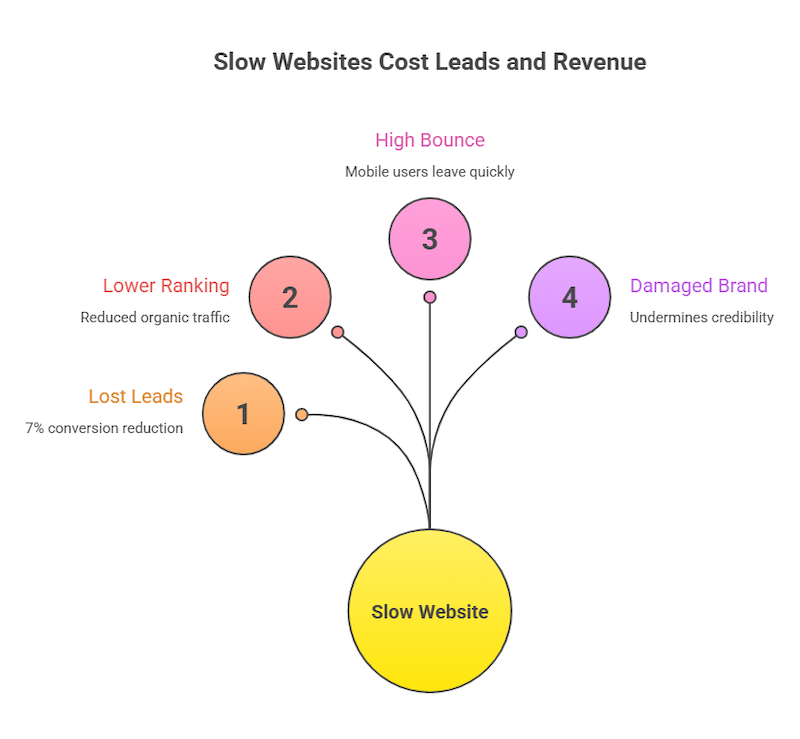
Website speed isn't just a technical concern; it has a direct impact on your bottom line:
- Every second counts: Research by Akamai consistently shows that a 1-second delay in page load time can reduce conversions by up to 7%. For a business getting 500 inquiries a month, that's 35 leads lost — not because your offer was wrong, but because your page was slow.
- Core Web Vitals affect your Google ranking directly: Poor scores on LCP, CLS, and INP don't just frustrate visitors; they signal to Google that your site delivers a poor experience. That can push your pages down in search results, reducing the organic traffic you'd otherwise be getting.
- Mobile bounce rates spike on slow pages: In Malaysia, a significant portion of web traffic comes from mobile users, and 4G coverage isn't consistent across all areas, particularly outside the Klang Valley. Google's own research found that when a page takes more than 3 seconds to load on mobile, over half of users will leave before seeing anything. No amount of great branding or compelling copy can convert a visitor who's already gone.
- Slow pages undermine your brand: If your website is slow, it creates doubt, even if everything else about your business is professional and credible. A fast, well-built website signals that your business is serious. A slow one does the opposite.
This is why website speed sits at the core of what we consider when building and maintaining websites for our clients. Whether you need a full redesign or targeted website load speed improvement, the goal is the same: a website that works as hard as your business does.
Optimising Page Load Time
Many businesses ask how to optimise website speed without knowing where to start. The most impactful place is almost always your images.
Large image files can severely slow down your website, so compressing and resizing images is essential. This can have a significant impact on page load speeds.
Using the right image format also helps; newer formats like WebP offer excellent compression and faster loading times.
Another important method for improving page load speed is to reduce HTTP requests. Every script, stylesheet, and plugin on your website generates an HTTP request, and the more requests generated, the slower your website will load.
To reduce these requests, limit the number of scripts and plugins on your website and, where possible, combine multiple stylesheets and scripts into one file.
Reducing HTTP requests can lead to noticeably faster load times and a better user experience overall.
Caching: An Effective Solution
Caching is an effective approach for increasing website speed and decreasing page load times.
It works by storing frequently requested content, such as images and web pages, on the user's device or a nearby server, so it doesn't need to be loaded fresh on every visit.
Browser caching is the most well-known method, storing web page resources on the user's browser for faster repeat visits.
Beyond browser caching, there are two other solutions worth knowing: server-side caching and Content Delivery Networks (CDNs). Server-side caching stores frequently accessed data on the server itself, reducing load and improving performance.
CDNs go a step further; they store copies of your website on servers across multiple locations, so users load content from whichever server is closest to them. This reduces latency and makes your site feel more responsive, wherever your audience is.
Used together, these caching solutions can make a meaningful difference to your website's speed and to the experience visitors have every time they land on your site.
How to Test Your Website Speed Right Now?
The quickest way to check website speed is to run a free website speed test, no developer needed. If you want to properly analyse website speed and understand what's causing the slowdown, these three tools give you the most useful picture:
- Google PageSpeed Insights: The most authoritative tool for Core Web Vitals scores and a reliable website speed check for both mobile and desktop. Enter your URL and get separate scores along with specific recommendations. Aim for a score of 90 or above on both.
- GTmetrix: A detailed website loading speed test that breaks down exactly which files are taking the longest to load, including waterfall charts. Useful for identifying plugin bloat and render-blocking resources.
- WebPageTest: Lets you run a website speed test from specific locations, including Singapore, which is the closest available node to Malaysia. Useful for understanding how your site performs for a local audience, specifically.
What to do if your scores are poor: If your PageSpeed score is below 50 on mobile, your site likely has multiple issues that need attention, image compression, hosting, caching, and potentially a rebuild if the page builder is the root cause. A web maintenance or web redesign conversation is worth having before the slow site continues costing you leads.
Conclusion
Website speed is critical to the success of any online business. With a growing share of users accessing websites from mobile devices, having a fast-loading site that delivers a smooth experience is no longer a nice-to-have.
Slow-loading websites frustrate visitors, increase bounce rates, and work against your SEO efforts. By optimising page load times, reducing HTTP requests, and applying caching solutions, you can significantly improve your website's performance and keep visitors engaged.
Speed is also a core part of your overall SEO strategy; search engines consistently favour websites that load quickly. In today's competitive market, don't let a slow website be the reason a potential customer chooses someone else.